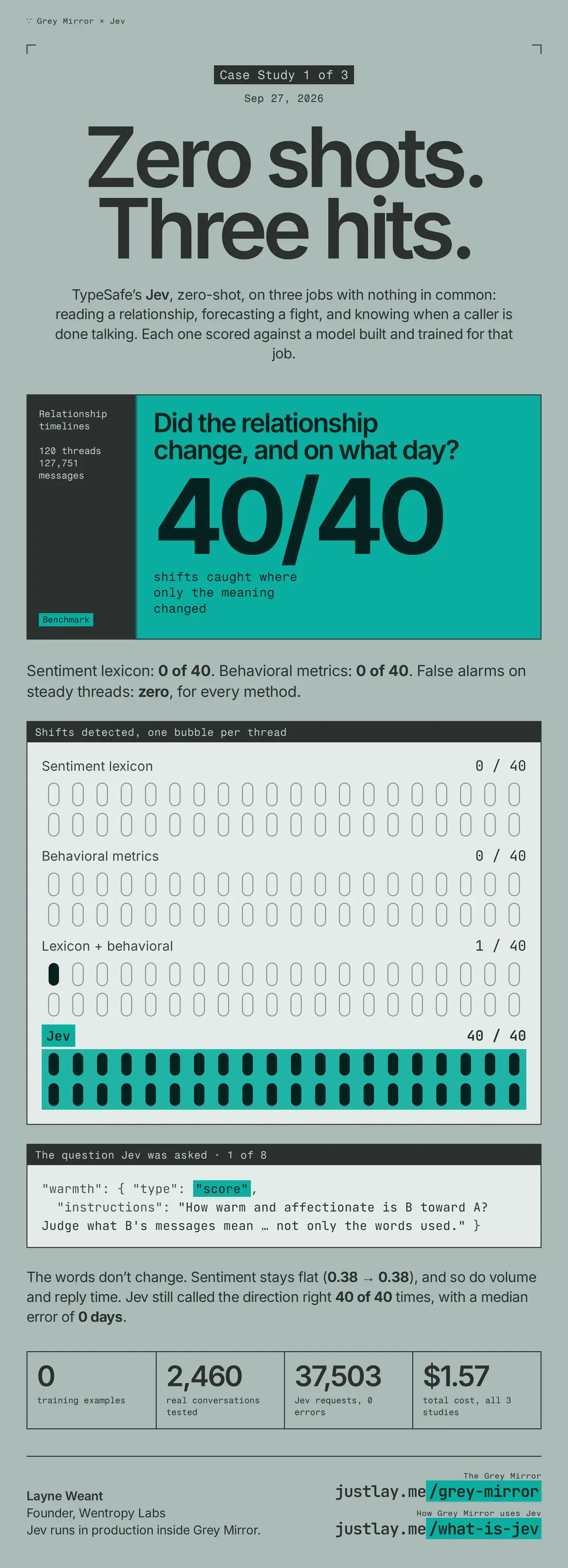
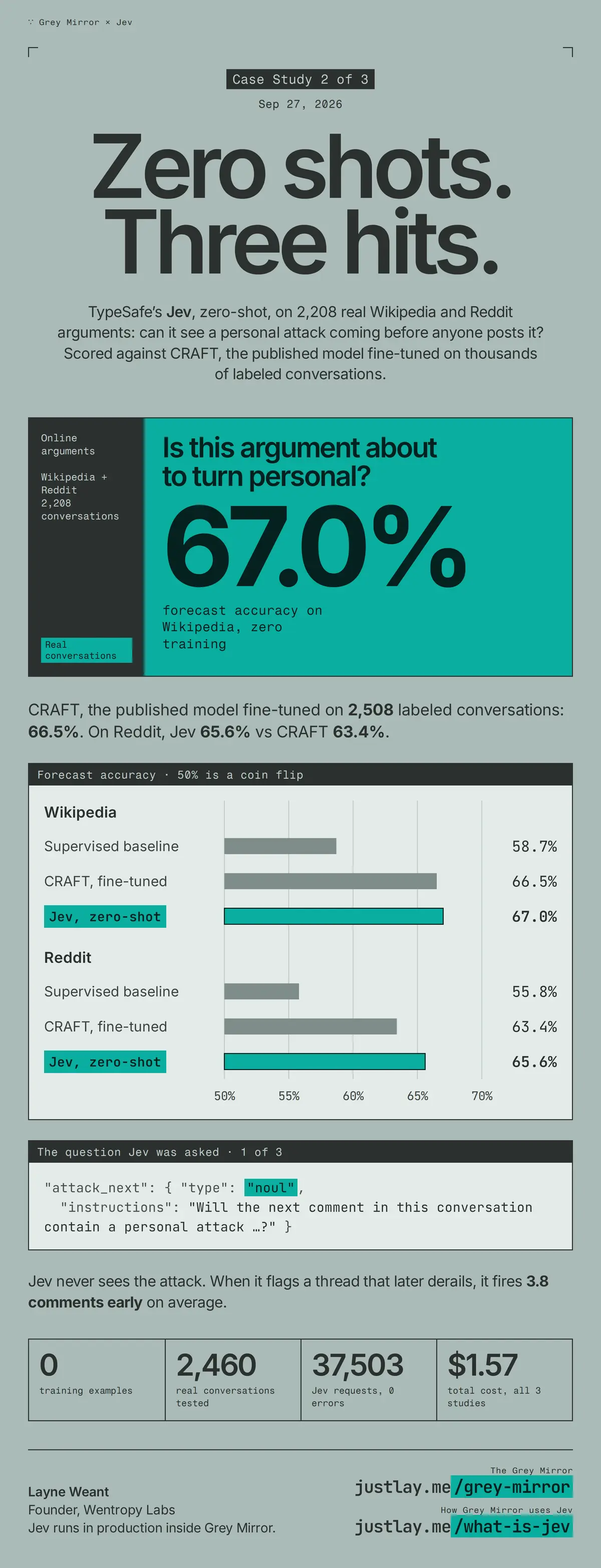
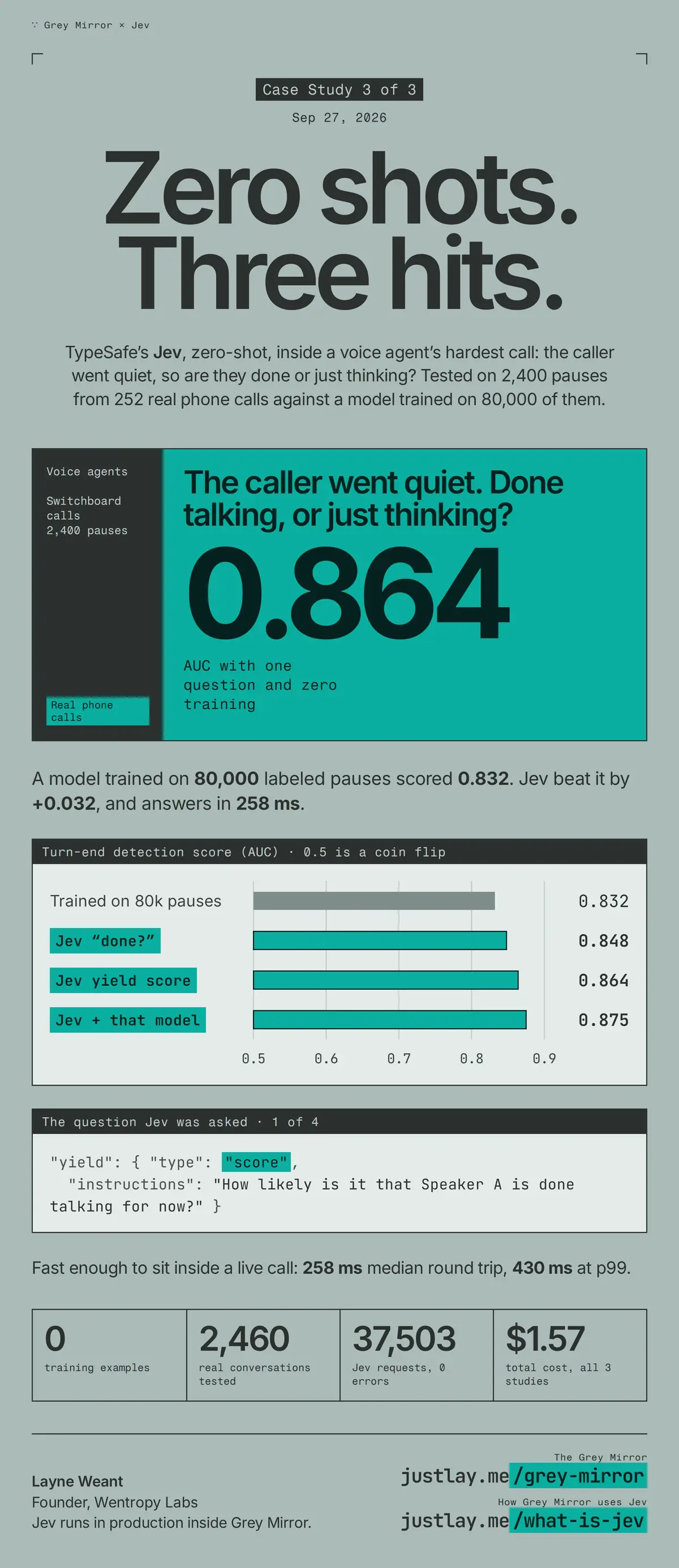
Jev is a decision model from TypeSafe AI. Grey Mirror asks it specific questions with a limited set of answers: which participant a message belongs to, whether a report statement fits the supplied facts, or whether a reply addresses the concern before it. Jev returns judgments and probabilities; Grey Mirror applies the rules for using them.
What changes when a model reads the exchange?
Consider an apology followed by “fine.” That reply might acknowledge the apology, accept it, or close the conversation without resolving anything. Counting the word “sorry” cannot distinguish those readings.
The episode feature asks separate questions: was there a repair attempt, did the other person acknowledge it, did they accept it, and did the conversation remain calmer for the next few turns? Separating those steps makes the finding easier to inspect and less likely to overstate what happened.
Four views being evaluated
These views use selected, bounded excerpts from the existing analysis. They do not claim to measure every exchange. Each view reports its coverage and keeps a route back to the original messages. They remain unavailable to customers while evaluation is in progress.
- Interaction DNA: see which conversation states follow one another, such as a disclosure followed by deflection. A connection shows order, not cause.
- Repair Funnel: compare each person’s attempts to reconnect with acknowledgment, acceptance, and a calmer continuation. A few calmer turns do not establish lasting change.
- Vulnerability Response Map: inspect how the other person responds when someone expresses hurt, fear, or need. A missing reply remains a missing reply, not evidence of intent.
- Question–Answer Fidelity: compare replies to emotional questions with replies to practical questions. No visible response means no score.
What to do with a finding
Start with the exchange behind it. Read the messages before and after the cited turn. Ask whether the finding still fits when you include what happened offline or what the export is missing.
Use a specific observation to start a conversation: “When I asked how you felt, we moved straight to planning the weekend. Can we come back to that question?” A report can help locate the moment; it cannot decide what either person meant.
For important claims, the new episode check asks three separate questions: does the evidence support the reading, is another reading plausible, and is the evidence sufficient? The rules allow, mark as tentative, or omit the reading. They do not change the original messages.
Where Jev fits
TypeSafe AI develops Jev. Grey Mirror accesses it through Vercel AI Gateway. Grey Mirror’s existing analyzers measure the conversation, Pattern Memory organizes episodes, and retrieval connects findings to evidence. Jev checks bounded questions about that material. The report-writing system remains separate.
Current integrations support participant attribution and checks on selected generated statements. That does not mean every sentence has been independently verified. Availability also depends on the feature configuration and whether the check succeeds.
What these checks cannot establish
Messages do not reveal private thoughts. A model cannot diagnose a person, establish someone’s motives, or prove that one message caused a later event. A probability expresses the model’s judgment under the supplied context, not the chance that an interpretation is objectively true.
A missing export section, sarcasm, a conversation continued in person, or an incorrect participant mapping can change the reading. The new views keep unknown results out of rates and disclose how much material was reviewed.
What is sent for a check
Jev does not receive the complete history for an episode check. It receives a compact excerpt with stable participant labels and source references. Known participant names and common contact details are masked before this excerpt leaves the server. Context can still identify people; redaction is not a guarantee of anonymity.
Selected report-claim checks use derived report facts and masked statements. The privacy policy explains the processors and data handling. Original evidence remains accessible only through the private report’s access controls.
Read the Grey Mirror methodology and privacy policy for more context.